
Can we boost density by restricting lower-density housing?
Is this "zoning, but good", or just more bad zoning?


Last year, a developer proposed to destroy a historic church in Chicago’s Wicker Park neighborhood and build three single-family homes in its place.
By most urbanists’ standards, this proposal was a woeful underdevelopment. The site is walkable to the Blue Line train and multiple high-frequency bus routes, in a popular and expensive neighborhood with access to all kinds of amenities. Much of the neighborhood’s historic housing stock is small-scale multifamily housing, such as old two and three-flats.
Due to a recent change in the zoning on Chicago’s Northwest Side, however, this development became illegal before it had the chance to receive permitting approval. The Northwest Side Preservation Ordinance (NPO), which went into effect in September 2024, disallowed this type of development in large sections of Logan Square and adjacent neighborhoods. Since its passage, the NPO has been much-ballyhooed for its rules around tenants’ opportunity to purchase and fees for demolishing new housing. More quietly, however, the ordinance effectively banned new single-family homes in much of the area. On any block where the majority of lots already have multi-family housing, all new development must have a minimum of two units per lot.
The developer returned with an updated proposal, which has now received zoning approval, that will preserve the church building as a residential conversion with 16 units (and 0 parking spots, made possible by Chicago’s loose — and now practically nonexistent — minimum parking requirements).
By any measure, this looks like a clear-cut urbanism success story. The historic church can be preserved and the development will be more dense, adding much-needed housing supply to a high-demand neighborhood. We can thank the NPO’s minimum density requirements for helping to prevent a much more disappointing development outcome.
This case in Wicker Park is representative of a common but relatively under-discussed strategy in zoning and land use reform: in addition to allowing more housing, some cities have also limited and restricted less-dense housing (where density is defined as the number of housing units on a property). As the YIMBY movement has become increasingly ascendant, this approach has popped up in various forms as a complement to more familiar upzoning policies.
While this approach could appeal to many urbanists, it also carries substantial risks, and must be used with caution. There are certainly circumstances where it could be an effective strategy for pro-housing advocates. But it could also negatively affect housing markets — and crucially, it won’t always be easy to foresee those downsides. Like any tool that seeks to directly manipulate housing market incomes using static regulations, we should be humble about unintended consequences, as it is likely impossible to ever perfectly calibrate this type of policy.
How do cities restrict less-dense development?
The simplest way to restrict less-dense development is to simply require a minimum density, banning housing that doesn’t create enough new homes.
This is what Chicago did with the Northwest Side Preservation Ordinance: for certain areas of Chicago, it is now illegal to build a single-family home.
This strategy is not exclusively used in residential neighborhoods. The Minneapolis 2040 Plan, which is most famous for allowing triplexes throughout the city, also created minimum heights and floor-area ratios for development in certain parts of the city. In Minneapolis’s downtown, development must be 10 stories tall with a 4.0 FAR, while different transit-adjacent areas have minimum heights ranging from 2 to 10 stories.
This policy has come into play a couple of times in the past few years. For example, in 2023, a developer wanted to build a seven-story, 135-unit building next to Minneapolis’s Prospect Park Green Line stop. However, the lot was zoned for a 10-story height minimum and city staff refused to grant a variance for a seven-story building. The development was rejected, and no new construction has occurred on the lot.
However, this approach doesn’t have to be as blunt as a complete floor on density. A milder flavor of it would be to still allow a variety of densities, but impose more restrictive limits on the size, bulk, or form of lower-density housing types.
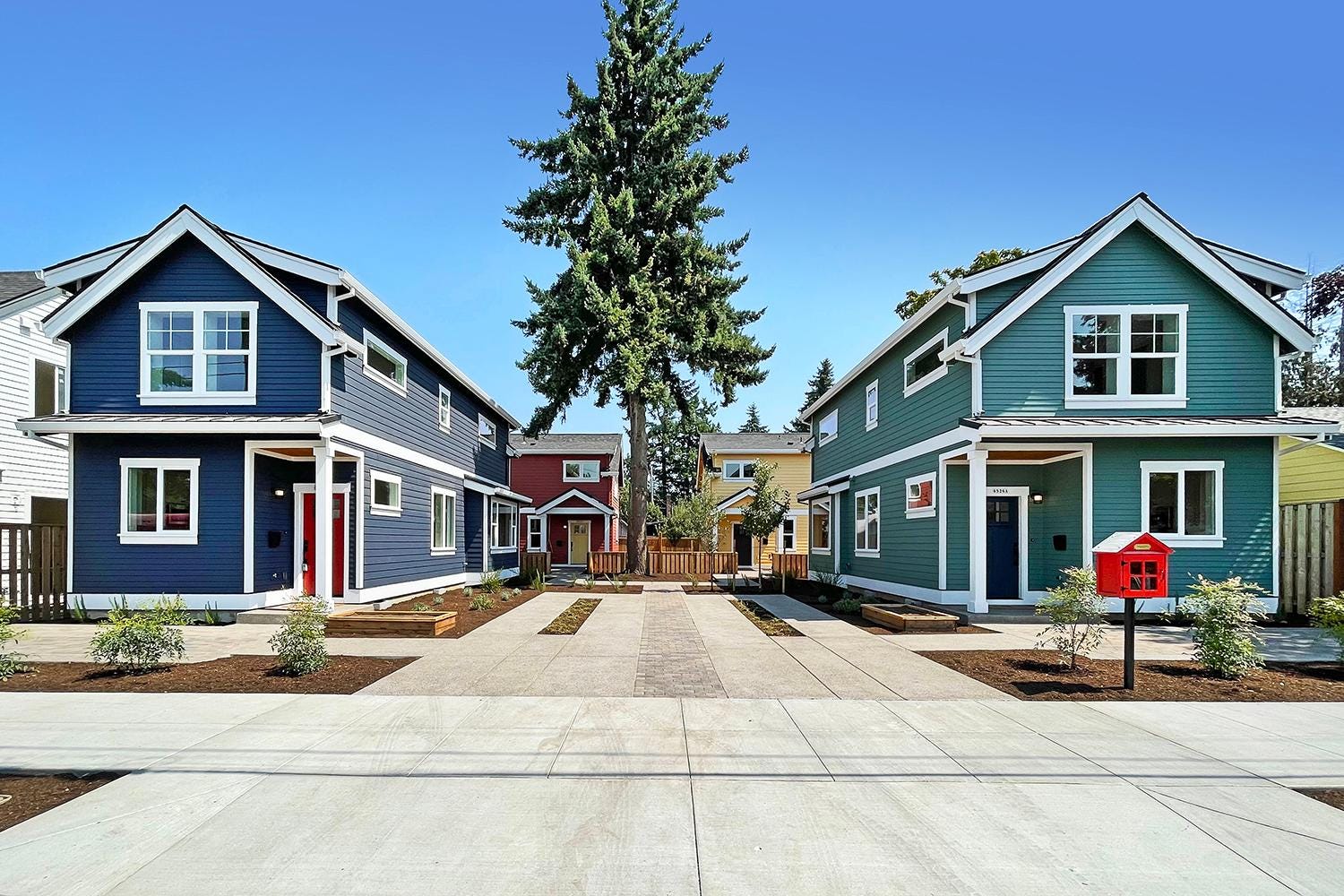
One example of this is in Portland, Oregon’s Residential Infill Project (RIP), which allowed fourplexes throughout the city. Prior to RIP’s 2021 implementation, single-family homes in Portland could be quite large. There was no limit on floor-area ratios, so huge houses were legal to build as long as houses weren’t too tall and didn’t cover too much of the lot. These types of homes were derided as “McMansions”.
With RIP, Portland allowed at least four housing units per lot across the city. Additionally, however, Portland also introduced a somewhat restrictive limit on floor-area ratios. This came with a regulatory wrinkle: the new floor area ratios were “stepped”, meaning that they increase for developments with more units. For example, in the prominent R5 zone, a single-family home has a maximum FAR of 0.5. But for each additional housing unit, the FAR increases by 0.1. Thus, a duplex can have a 0.6 FAR, a triplex can have a 0.7 FAR, and a fourplex can have a 0.8 FAR.
The express purpose of this policy is to restrict lower-density forms of development so they are less attractive to build. When I talked to Portland city planner Morgan Tracy about this in 2023, he explained that the city’s planning commission sought to “provide a disincentive to building just a single house and [they wanted] to really encourage these other housing types.”
This policy could seem attractive, as it particularly promotes the type of infill density that urbanist advocates support. But it should still be understood as a “restrictive” form of zoning in some sense; it functions by imposing limitations on single-family homes. Many of the large, “McMansion” houses previously built in Portland were no longer legal under RIP.
Finally, maximum parking requirements are a very closely related kind of policymaking. In recent years, many cities have eliminated minimum parking requirements, which is a a highly effective land use reform. In addition to removing these minimum rules, however, some cities have also instituted a maximum on the amount of parking that can be built in new housing. Portland and Minneapolis have instituted such maximums, and they sit among a host of other cities that have done the same. The logic is very similar to anti-McMansion regulations: in addition to removing a regulation that limits density (parking minimums), cities that implement maximums are seeking to force the market to build more urbanist-friendly housing — in this case, by limiting the total parking.
What problem do we solve by restricting lower-density housing?
If there are no regulatory barriers to higher-density housing, why does lower-density housing sometimes still get built instead? Understanding this dynamic helps elucidate the potential benefits of using zoning to disfavor less-dense development.
Of course, all housing markets have a limit to how much density they could support. If a neighborhood is cheap enough that most people can afford single family homes, then there will likely be few duplexes, even if these are incentivized by the zoning code. In such a case, requiring minimum densities of development, or even applying more restrictive rules to lower-density buildings, is risky because it could ultimately prevent any development from happening at all.
In other cases, however, multiple densities might be economically feasible to build in a neighborhood. Most of the time, developers can make more money by building the densest development possible, allowing them to sell or lease more units.
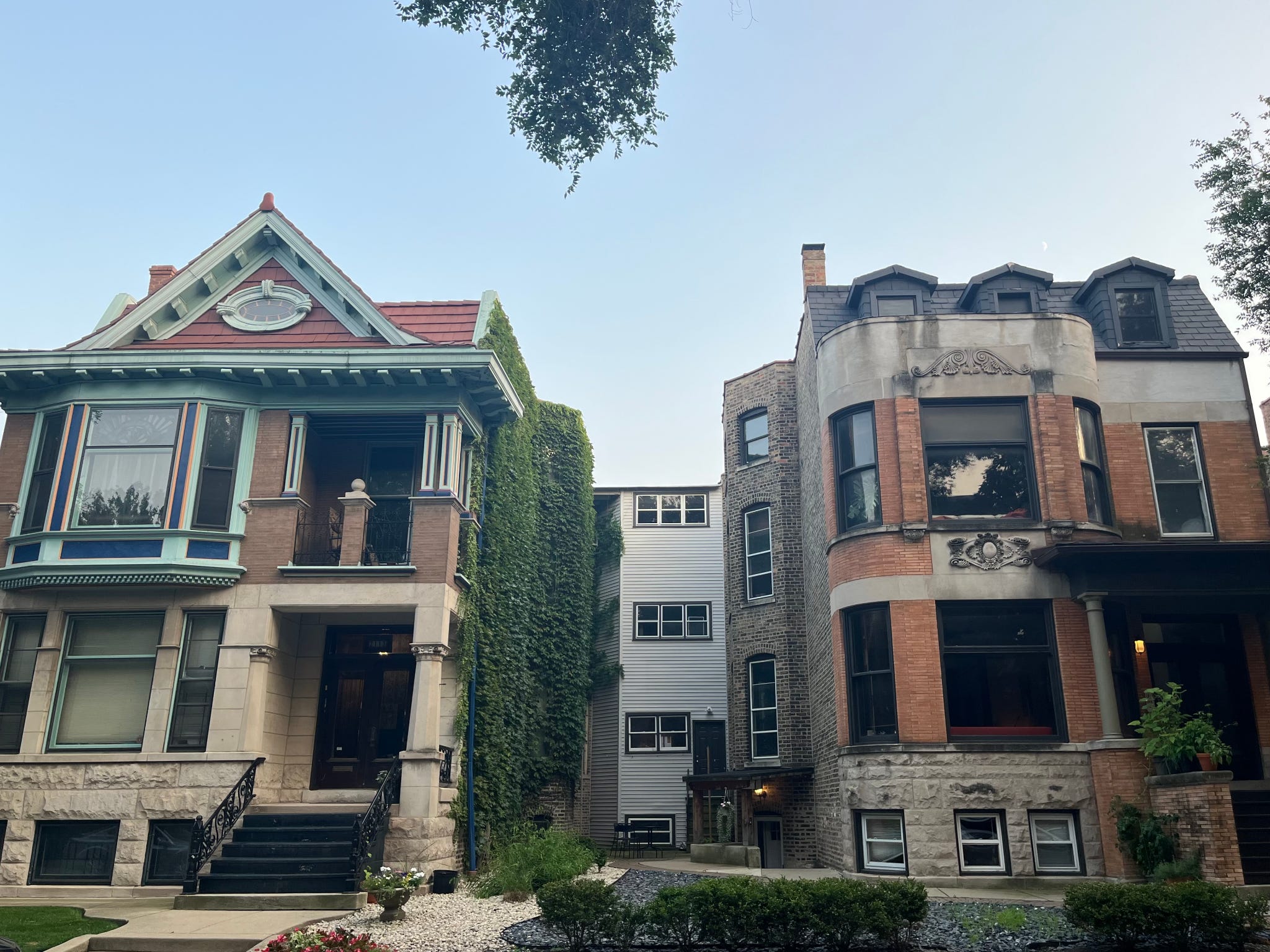
It’s possible, however, that developers might actually make more money by building a less dense development — even if the market would also support a denser development. This is what appears to be happening in some Northside neighborhoods of Chicago, such as Lincoln Park and Lakeview, that are encountering widespread “deconversions” of older 2-4 unit buildings into single-family homes. These neighborhoods are full of old three and four-flats, and even still get occasional new construction of these building types today. However, homebuyers in these places seem to place a huge premium on single-family homes, and they’re willing (and able) to pay higher prices per square foot than a 2-4 unit building would warrant. This results in a growing number of single-family homes, even though the neighborhood clearly has sufficient demand to support significantly higher density.
Chicago’s deconversions represent one scenario where less-dense housing types could outbid denser, but still economically feasible, apartments.
This type of scenario suggests a more nuanced benefit from restricting lower-density housing. Here, the problem is that denser housing is economically viable, but wealthier homebuyers can outbid the potential residents of a new 2-4 unit building.
In these situations, zoning and land use policies can be used to “box out” those who are able to pay very high prices per square foot. This could be done by altogether banning single-family homes, or it could be done by applying more restrictive rules to them, as Portland has done. Cities are effectively forcing the hand of the market to build more densely, and there is something to be gained as a result. But what are the tradeoffs at play?
Potential tradeoffs of this strategy


The most straightforward potential pitfall of restricting lower-density housing is that you might over-mandate density, and kill development altogether. Of course, policymakers working in good-faith will seek to avoid this. Yet this outcome might be surprisingly difficult to avoid.
Earlier, I mentioned a case where Minneapolis rejected a 7-story apartment right next to a station on the city’s Green Line light rail. The building did not meet Minneapolis’ 10-story minimum for that area. However, the developer never returned with a denser development proposal, claiming that this wouldn’t be economically feasible, and today that lot still has a one-story restaurant.
Meanwhile, Minneapolis is struggling to build housing of any kind, as interest rates stay high and the housing market experiences a general slowdown. In this instance, I don’t think anyone would argue minimum height requirements have made the city better off.
Now, city policymakers are recognizing the downsides of their minimum density mandates. In an August 2025 presentation, Minneapolis planning staff recommended reducing the minimum height limits in certain transit corridors, while adding a suite of carve outs for certain types of developments. It’s an acknowledgement that they have over-mandated density in certain parts of the city, ultimately harming development.
Is this outcome avoidable if cities perform careful analyses, and thoughtfully craft policy to make sure that their minimum density levels are economically viable? That’s an admirable approach — it’s certainly better than not carefully considering the impacts — but I don’t think it’s a reliable solution. It’s hard to anticipate every development scenario, and the economic conditions that shape housing markets are ever-changing.
In fact, as Minneapolis Public Radio reported in May 2025, minimum height requirements have created issues for some small business owners whose buildings were severely damaged during protests after George Floyd’s murder in 2020. Many of these businesses, which were often in one-story buildings, are on neighborhood arterial streets that now mandate at least two stories. Some business owners have struggled to make this work — leaving them unable to rebuild after 2020 protests. Even the most thoughtful, analytical planners could not have predicted this issue when they began rewriting Minneapolis’s zoning code in 2018 (although the zoning rewrite wasn’t finalized until 2023).
To me, this scenario suggests it might not be possible to restrict lower-density housing without entirely avoiding the risk of stifling development. We can’t always ensure that our rules and regulations will be perfectly calibrated.
However, altogether stifling development isn’t the only potential tradeoff. Even low-density development provides value for somebody. When single-family homes outbid a duplex, there is a reason for that (even if part of the reason is that the buyer of the home is rich). For example, when I wrote about deconversions in Chicago’s Northside, I showed that families were far more likely to live in single-family homes than multifamily housing. I theorized that the deconversion boom in neighborhoods like North Center/Lincoln Square and Lakeview could help explain why these neighborhoods are some of the only neighborhoods in the city with a growing number of families.
We can fairly decide that we would rather prioritize the goal of densification. But we should recognize that restricting lower-density housing makes someone worse off. We can’t call it a Pareto improvement.
This also brings us to a broader critique of this approach to planning and policymaking in housing. As Reason journalist Christian Britschgi has pointed out, groups with varying ideologies, from Trump-adjacent conservatives to New Urbanists, are happy to critique certain housing regulations while maintaining regulations that favor the housing types they deem “desirable”.
These kinds of policies that seek to directly shape the housing market face a fundamentally unavoidable challenge: the housing market is complex and ever-changing, and no policy can ever be perfectly calibrated to avoid causing some downsides, sometimes. This also echoes the great anthropologist James C. Scott, who advanced similar ideas in Seeing Like a State. Housing markets, like all social systems, are complex and interconnected in ways that no individual can fully comprehend. There will always be imperfections when we create prescriptive rules in an attempt to mandate the exact housing outcomes we want.
This is an issue where reasonable zoning reform advocates might disagree. It’s easy to point out that zoning is bad when it limits density. But can zoning also be bad because it is altogether too controlling, no matter the direction? I’m inclined to say that this is indeed bad: using zoning to restrict less-dense housing is risky business, and there’s rarely a case where reformers need to use such a tool.
I'll repeat my usual annoying refrain that this seems like an issue where the far more sensible suggestion is a Land Value Tax. (That is, a property tax entirely focused on the value of land rather than on the land+buildings)
Namely, this encourages density through market mechanisms rather than executive fiat. If an area is valuable, the LVT is higher (regardless of what buildings exist or will exist) and thus density would most likely result. That or more valuable homes, if there's enough of a market for it.
That's the beauty of LVT, it doesn't really care what you put there, so long as you're willing to pay for the privilege. If it makes economic sense, it can happen. If not, it won't, which would itself be reflected in the land value. You get productive land use without heavy regulation.
"
Even the most thoughtful, analytical planners could not have predicted this issue
"
That's a generous take. But unless I'm misunderstanding what's in play predicting a minimum height requirement is pretty straight forward --> if it becomes law, you can only build a building that is at least that high. Now one could argue the extent of destruction, the scale and sheer numbers unable to rebuild, wasn't predictable but how the ordinance works was quite predictable.